
The power of continious experience and discovery
Think back to the last great film that completely pulled you in.
You're sitting in the cinema. The lights have gone down. The conversations around you have stopped. That enormous screen fills your vision and, somewhere along the way, the room you're sitting in seems to disappear.
You're not checking your phone. You're not looking at your watch to see how much longer you've got to sit there. You're not wondering what else is showing in the cinema next door. You're certainly not thinking about getting up and leaving halfway through.
You're in.
You're following these people wherever they go. You want to know what's behind the door they're about to open. What's waiting around the corner. Who they're going to meet. Whether they'll make it to wherever they're trying to get to. You become curious about a world that didn't even exist for you a few minutes earlier, and now you don't want to leave it.
Then something remarkable happens.
Two hours disappear.
The credits begin to roll, the lights slowly come back up and suddenly you're back in the cinema again. Perhaps you sit there for another moment before getting out of your seat. Maybe you walk outside still thinking about what you've just seen.
You might feel exhilarated. Inspired. Moved. Satisfied. Perhaps even a little sad that it's over.
Or maybe you can't explain exactly why you enjoyed it so much.
You just know that for the last couple of hours, it had you.


So what happened?
How did a series of moving pictures keep you so engaged that you happily gave them two hours of your attention?
There isn't one answer, of course. Great filmmaking brings together story, characters, performance, sound, music, lighting, cinematography, editing and countless other ingredients.
But there are some deceptively simple ingredients that interest us enormously at Glassnik:
You kept going somewhere.
You kept moving forward.
The world kept changing.
New people kept entering it.
And you kept discovering what came next.
One of the most famous sequences in Goodfellas shows just how powerful something as simple as continuing to move forward through a changing environment can become.
Henry and Karen arrive at the Copacabana, but instead of simply cutting from outside the club to the pair sitting at their table, the camera goes with them.
Across the street.
Down the stairs.
Around the corner.
Along the corridor.
Through another doorway.
Into the bustling kitchen.
Past cooks, waiters and people going about their work.
Through another passage.
And eventually, out into the nightclub.
And we're glued to it.
For almost three minutes, we keep moving forward with them.
We know we're going somewhere, but we don't know exactly how we're going to get there — and, crucially, we don't know what we're going to discover along the way.
Every few seconds the world gives us something else.
Another corner. Another doorway. Another room. Another change in lighting. Another change in atmosphere.
And another person.
People appear in front of Henry and Karen, acknowledge them, move around them, speak to them, make way for them or simply continue with whatever they were doing before Henry and Karen entered their world.
That's important because people can transform an environment just as quickly as the environment itself can change.
An empty corridor suddenly has somebody walking towards us. A kitchen is alive with cooks and waiters. We emerge into the nightclub and we're surrounded by an entirely different collection of people.
The physical journey keeps changing, but the human landscape keeps changing with it.
Forward movement keeps creating anticipation.
What's around that corner?
Where does that corridor lead?
Who's through that doorway?
Who are we going to encounter next?
Where are we going to emerge?
And every time one of those little questions is answered, the movement creates another one.
We're engaged. We're curious. We're immersed.
We're not impatiently waiting for Henry and Karen to reach their table so the film can get on with the story. Getting there has become part of the story.
The journey has become the Experience.
1917 takes that feeling of continuous movement and discovery and stretches it across almost an entire film.
We begin by following two soldiers through the First World War landscape as trenches lead into dark bunkers, bunkers give way to devastated open fields, and the journey carries us past bodies, through mud and barbed wire, across fields and towards ruined buildings.
The environment is continually changing around us, but our journey through it feels unbroken.
And just when we begin to settle into one environment, something else happens.
An aircraft appears overhead.
Suddenly there's movement in a part of the frame that hadn't been important moments earlier. We watch it fighting in the sky. It's hit. It begins coming down.
And then the aircraft comes crashing into the world we've already been travelling through.
The Experience has changed again.
But 1917 also demonstrates something even easier to overlook: people keep changing the Experience too.
Characters enter the soldiers' journey and leave it again. They encounter other soldiers. Officers appear. Groups pass through. Someone provides information or assistance. Someone disappears from the journey and the remaining character continues alone.
Later, while moving through the ruins of the French town of Écoust, Schofield discovers a young French woman hiding with a baby.
Moments earlier we're following a soldier alone through a terrifying ruined environment.
Then he enters another space.
And suddenly somebody is there.
The mood changes almost immediately.
The location hasn't needed to change. We haven't jumped somewhere else. There doesn't need to be an explosion or some enormous piece of action.
Another human being has entered the Experience, and that's enough to make it different.
But 1917 keeps changing in other ways too.
The journey continues through orchards and abandoned buildings, across water and through devastated towns. Day becomes night. Bright open landscapes become dark interiors. The ruined town is illuminated by fires and flares, completely transforming the world around Schofield. Eventually darkness gives way again and the journey continues into another day.
We don't simply observe a collection of locations, people, events and lighting conditions.
We experience the transitions between them.
And that's important.
A conventional edit can instantly show us somewhere new.
Continuous movement allows us to discover how we got there, who we encountered along the way and how the world changed around us while we were moving through it.
Extraction throws the same idea into the middle of frantic action. Its extended sequences carry us through rooms, corridors, staircases, rooftops, streets and vehicles, while fights, pursuits and new characters continually enter and leave the action around us.
And sometimes the movement isn't simply forwards.
During one extraordinary sequence, Chris Hemsworth's character goes out of an upper floor towards the street below, and the camera follows the descent.
In moments, our entire relationship with the environment changes.
We're no longer looking at the world from several floors above it. We're travelling down through that space and arriving back at street level with the action.
Elevation itself becomes part of the discovery.
Filmmakers have understood the power of changing elevation for generations. That's one reason overhead shots can be so effective. After spending time with characters at street level, suddenly seeing the same world from several floors above can make a familiar location feel completely different.
Film crews may go to considerable effort simply to capture a few seconds from an elevated viewpoint — gaining access to rooftops, upper floors, balconies, cranes or other vantage points — because those few seconds can completely change the viewer's perspective and break up a succession of street-level images.
A street from the pavement is one experience.
The same street from ten floors above is another.
And then there's Russian Ark, which pushes continuous discovery in another direction entirely.
The entire feature-length film unfolds as one continuous shot through the Hermitage Museum. We pass through doorway after doorway and room after room, encountering different architectural spaces, artworks, performances, periods of Russian history — and continually encountering new people.
A room that we haven't entered yet contains people we haven't met yet.
Every doorway becomes a little invitation:
What's through there?
And perhaps just as importantly:
Who's through there?
These films couldn't be more different. A gangster entering a nightclub. Soldiers crossing a battlefield. A mercenary fighting his way through a city. A journey through centuries of Russian history.
But something fascinating connects them:
Change becomes part of what keeps us watching.
Our location changes.
Our elevation changes.
The people around us change.
The action changes.
The light changes.
A doorway appears and we wonder what's behind it. A corridor stretches ahead and we anticipate what's waiting at the other end. Someone walks towards us who wasn't there moments earlier. We descend a staircase and can't yet see what's below. We leave a dark interior and emerge into sunlight. We climb higher and suddenly see the world from above. Something appears in the distance and gradually gets closer.
Before one discovery has even arrived, our brains can already be anticipating the next.
That simple cycle — movement, anticipation, curiosity, discovery — can keep pulling us forward without constantly interrupting what we're watching.
Filmmakers have spent generations learning how to use it. They move cameras through changing environments, conceal and reveal information, introduce new characters, approach things gradually, change elevation and use light and darkness to transform how those environments feel.
Our brains don't simply wait for these discoveries.
We anticipate them.
Curiosity builds around what we haven't seen yet, and there's satisfaction when it's finally revealed.
And here's something worth remembering: cinema learned that our brains don't need a new clip every few seconds to keep us watching.
Give us somewhere interesting to go. Keep us moving through it. Let the world unfold.
Our own curiosity, anticipation and desire to discover can do an extraordinary amount of the work.
Social media has increasingly taken moving pictures in a very different — and often more unsettling — direction.
Another clip. Another swipe. Another notification. Another burst of novelty. Another promise that perhaps the next thing will finally satisfy us.
A great film can hold our attention for two hours through movement, anticipation and discovery and leave us feeling exhilarated, moved or deeply satisfied. Two hours of compulsive scrolling can leave us feeling restless and fragmented while, strangely, still wanting to continue.
That's an important distinction.
One can keep us engaged in an experience; the other can keep us craving the next stimulus.
And on the other side of that relationship are millions of content creators competing for the next view, Like, Share or Follow — fighting to stop the thumb for a few more seconds before the viewer swipes to somebody else.
That competition has created its own visual language: faster hooks, shorter clips, more cuts, captions, reactions, music, zooms and constant new stimulation.
The creator fights to stop us swiping; the platform always has another video waiting if they fail.
Cinema offers a profoundly different relationship with our brains — and at Glassnik, that's the relationship with moving pictures that interests us.
Movement can sustain our attention.
Anticipation can build.
Curiosity can grow.
Discovery can provide its own reward.
And now take those principles out of the movie studio and put them into the real world.
Suddenly, many of these changes are everywhere.
Walk along a beach and a headland appears in the distance. Keep walking and discover what's around it.
Enter a market from a bright street and watch the light and atmosphere change around you. Follow a narrow passage without knowing what will open up at the other end.
And let people enter the Experience naturally.
Walk through a market and a vendor catches your attention. Someone approaches to show you something. A waiter arrives at your table. A friend joins you halfway through a walk. A stranger asks a question. Children run past. Someone waves. A street performer appears ahead. You turn a corner and discover a crowd you couldn't see moments earlier.
You don't need to script any of it.
People are continually entering and leaving our field of vision in everyday life.
And this is where smart glasses change what's possible.
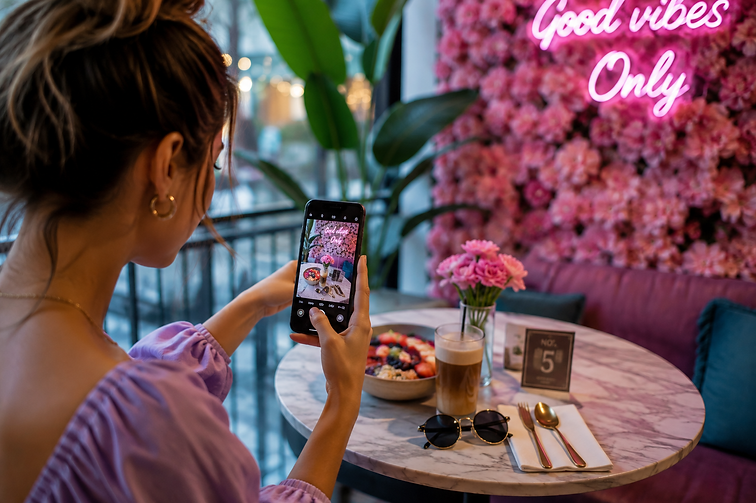
For years, capturing the world around us with a mobile phone has meant interrupting the very experience we're trying to record.
Something catches your attention.
You stop or slow down.
You reach for your phone.
Take it out.
Open the camera.
Raise it in front of you.
Look at the world through its screen.
Work out what you want in the shot.
Then start recording.
And once you're recording, the camera doesn't naturally share your point of view. You have to keep deciding where to hold it, how high to hold it and which direction to point it. Lower your hand and the camera angle drops with it. Turn the phone and the perspective changes. Move the phone away from your face and the camera moves somewhere your eyes aren't.
For those moments, you're doing something very different from simply experiencing the world.
You're operating a camera.
And there's another habit the mobile phone has encouraged.
We don't just capture the moment. We increasingly try to perfect it.
Someone walks into the background just as the picture is taken.
Take it again.
There's an ugly car behind us.
Move over there.
Someone walks behind the person we're filming.
Wait until they've gone.
The light isn't quite right.
Try another angle.
The photograph is taken and immediately everybody looks down at the screen to inspect it.
Do we like it?
Maybe not.
Take another.
And another.
And another.
Think about something as ordinary as a gym progress photo. The apparent purpose is simply to record how somebody's body looks that day. But it's easy to take ten or twenty versions trying to find the exact position of the hands, the most flattering angle of the face, the right posture and the lighting that makes the muscles look their most defined.
Then comes the selection.
Which one looks best?
Perhaps the crop changes. The exposure changes. The contrast changes. A filter gets added.
Eventually one image survives.
And ironically, the supposedly candid image of real life may be the least representative moment of the twenty that were actually captured.
Social content can work the same way.
A person walks into the shot?
Reshoot.
Someone interrupts?
Start again.
The background isn't perfect?
Move.
The lighting isn't flattering?
Find better light.
What we're eventually shown can be a carefully selected, repeated, framed and polished version of reality.
Glassnik is interested in something different.
What actually happened while you were there?
That's where smart glasses become particularly interesting.
A high-resolution camera is already built into the frame, sitting right beside your eyes.
Something interesting appears ahead?
“Record video.”
And keep going.
That's it.
You keep walking. You keep looking. You keep moving forward. You keep discovering.
There's no phone to pull out. No screen to raise between yourself and the world. No need to stop and compose everything through a rectangle in your hand.
And something else important happens.
The camera angle stays with you.
Walk forward and it moves forward with you. Turn your head and it turns with you. Look left and the camera moves left. Look right and it moves right. Climb the stairs and it climbs with you. Walk through the doorway and it goes through with you.
The relationship between your eyes and the camera remains remarkably consistent.

And because the camera is positioned right beside your eyes, that consistent camera angle is naturally Eye-POV.
You're not trying to imitate a first-person perspective by holding a phone somewhere near your face. You're simply looking at the world as you normally would while a camera beside your eyes captures approximately the same perspective.
And then there's perhaps the most interesting difference of all.
Don't keep stopping to perfect what happens next.
Someone walks into the frame?
Let them.
A delivery rider suddenly crosses in front of you?
Keep going.
A vendor calls out to you?
Turn and look.
A waiter unexpectedly arrives at the table?
They're now part of the Experience.
A child runs past. Someone laughs. A door opens. A crowd appears. A car briefly blocks the view. Someone you weren't expecting starts talking to you.
These aren't necessarily mistakes.
They're life.
And for Glassnik, those little imperfections can be some of the most interesting parts of the Experience.
The person who unexpectedly enters the frame may give us exactly the human change we've just seen filmmakers use so effectively. The passing vehicle creates movement. The interruption changes what happens next. The imperfect lighting changes as we move somewhere else.
Instead of repeatedly reshooting reality until it looks perfect, we can allow reality to keep happening.
That's a very different relationship with the camera.
Four simple ideas sit at the heart of it:
Say “Record video” and keep going.
The camera stays with you.
The perspective is naturally Eye-POV.
And when real life wanders into the frame, let it.
Suddenly, continuous real-world filmmaking becomes much more natural.
Ride an escalator through a shopping centre and another floor gradually opens up in front of you.
Keep going.
Walk upstairs and look back down at where you've just been.
Cross a pedestrian bridge and watch the traffic from above.
Take a glass lift and see the world fall away beneath you.
Walk onto a balcony. Climb a hill. Reach an observation deck.
Step onto a rooftop and look down at the streets you were walking through minutes earlier.
The change in elevation can become part of the Experience itself.

Instead of cutting from the street to an overhead establishing shot, the viewer can experience the journey from one viewpoint to the other.
And keep going.
Afternoon becomes golden hour.
Golden hour becomes sunset.
Buildings switch on their lights.
The sky darkens.
Streets that looked completely ordinary an hour earlier take on another character at night.
The Experience keeps changing because the world keeps changing.
None of this needs a Hollywood film set.
Smart glasses with high-resolution cameras built into their frames put the camera right beside our eyes. Combine that camera with the Videographer's own body and the constantly changing real world, and suddenly many of the ingredients that filmmakers have traditionally needed cameras, camera operators, Steadicams, dollies, tracks and carefully planned shots to create are already there.
The Videographer becomes the cameraman.
Your eyes determine where the camera looks.
Your head provides the pan and tilt.
Your body carries the camera forward.
Your feet become the dolly and the dolly track.
Stairs, lifts and escalators change the camera's elevation.
The real world provides the set.
The environment provides the scenery.
The places you move through provide constantly changing light — step from a bright street into a darker market, move from sunlight into a softly lit café, pass through rooms with completely different lighting, or emerge from a dark interior back into brilliant daylight.
People enter and leave the frame without being cast.
Weather changes.
Traffic moves.
Doors open.
Crowds appear.
Day becomes night.
And the high-resolution camera beside your eyes keeps moving through all of it with you.
That's what makes smart-glasses Eye-POV video so interesting for Glassnik. We're not simply putting a camera somewhere new. We're putting a capable camera at almost exactly the viewpoint from which human beings already move through and discover the world.
Suddenly, many of the cinematic ingredients we've just been exploring aren't reserved for a Hollywood production.
They're around us every day.
A shopping centre escalator can give us a changing elevation. A rooftop can give us the overhead perspective a film crew might work hard to obtain. A market can provide changing environments, changing light and a constantly changing cast of people. A walk beginning in late afternoon can move naturally through golden hour, sunset and into the lights of the city at night.
And none of those changes necessarily require a cut.
The Experience itself keeps changing.
That's where Glassnik begins to explore the same fundamental principles in a completely different setting.
We don't need to fight for another Like every few seconds or constantly persuade you not to swipe away. We'd rather give you somewhere worth going, then give you the time to experience it.
Slow down. Sit back. Relax.
Let the Experience unfold.
And when you're ready to go somewhere else, you choose where you go next.
Explore another street. Enter another city. Discover another country. Find another kind of Experience entirely. Glassnik can help you discover what's available, but the choice remains yours.
Instead of an infinite feed continually deciding what should appear next, you explore, you choose and you experience.
That's why continuous experience and discovery mean something quite specific to Glassnik. We're not simply talking about making videos longer.
We're exploring whether moving through the real world — as places, people, perspectives, light and life itself continually change around us — can become part of what keeps us watching.
Movement creates anticipation. Anticipation creates curiosity. Curiosity makes us want to discover what comes next.
And perhaps we've become so accustomed to scrolling that we've forgotten something remarkably simple.
Not every moving picture needs to prove itself to us in two seconds.
Not every quiet moment needs to be skipped. Not every pause means nothing is happening. Not every ordinary street needs a hook, a cut, a caption or somebody shouting for our attention.
Not every second of a video needs to audition to stop your next swipe.
Sometimes something interesting is just around the corner.
Sometimes somebody unexpected is about to walk into the Experience.
Sometimes the light is about to change.
Sometimes we're about to discover something we couldn't possibly have known was there.
But we'll never find out if our finger is already poised over the screen, ready to swipe the moment nothing spectacular happens.
So keep holding your phone.
Just give your thumb a rest.
Stay with one place for a while.
Let your mind settle into the Experience rather than asking it to decide every couple of seconds whether it's time to scroll to the next video.
Keep moving.
Keep looking.
Keep discovering.
Because sometimes the world unfolding in front of us is more interesting than another swipe.
And perhaps when we give our fingers — and our minds — a chance to relax, we might rediscover something cinema has known for more than a century: We don't always need to scroll to another video after a second or two. Sometimes we just need to stay with the Experience long enough to discover what happens next.